

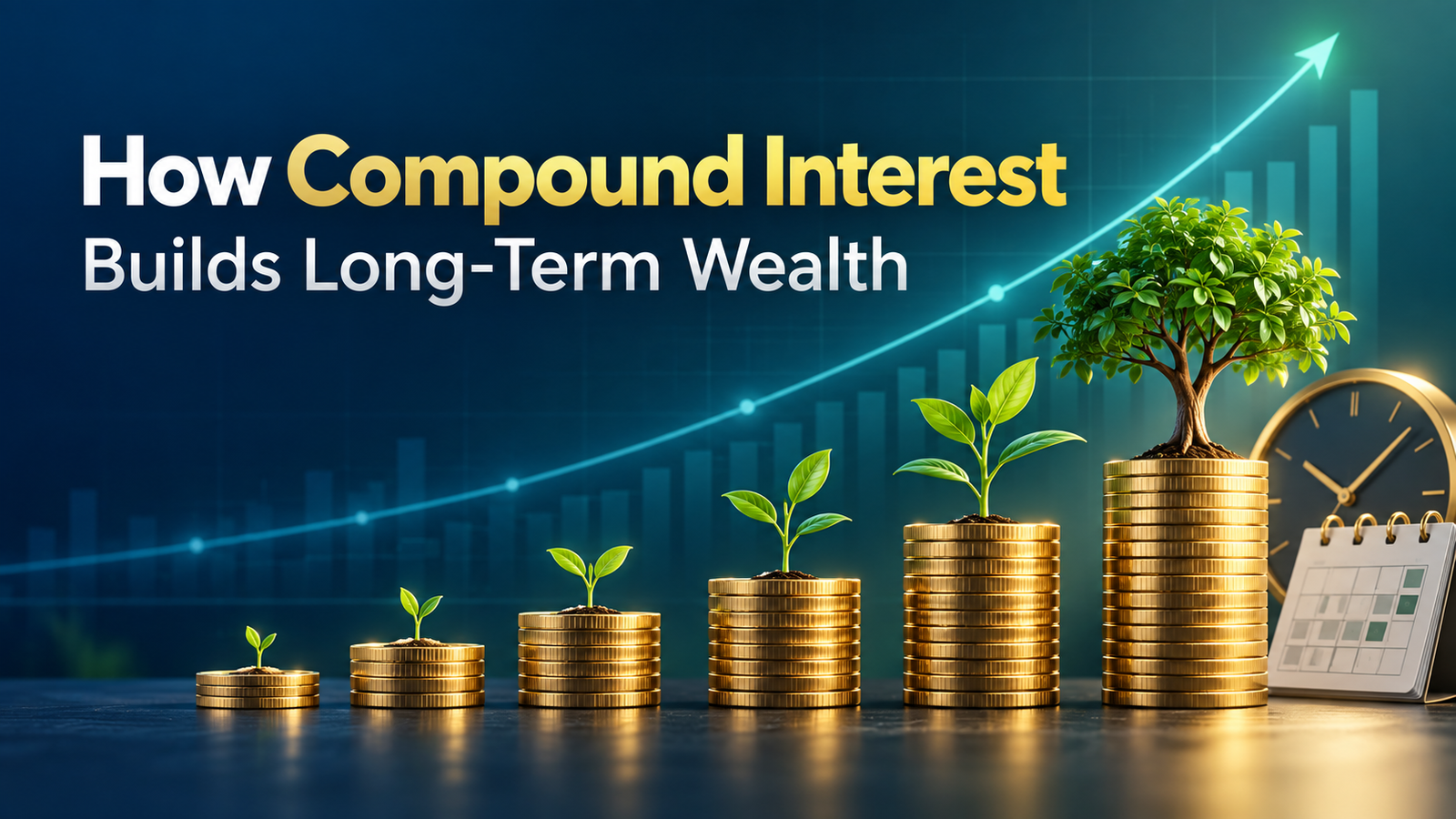
Building wealth is often associated with earning a high income or making a large investment. While both can be helpful, time and consistency can also play an important role in financial growth.
Compound interest allows money to grow not only from the original amount saved or invested but also from the returns previously earned. Over a long period, this repeated growth can make even relatively small contributions meaningful.
Understanding how compounding works can help you appreciate why starting early, contributing regularly, controlling fees, and remaining patient are important parts of a long-term financial plan.
What Is Compound Interest?
Compound interest means earning interest on both your original principal and the interest that has already accumulated.
Suppose you deposit $1,000 into an account earning 5% annually.
After the first year, you would earn $50, bringing the balance to $1,050. If the same rate applied during the second year, you would earn 5% on $1,050 rather than only on the original $1,000.
Your second-year interest would be $52.50, creating a balance of $1,102.50.
The extra $2.50 may seem small, but the effect becomes more noticeable when compounding continues over many years. Investor.gov describes compound interest as interest earned on interest and illustrates how returns can build upon earlier returns.
Simple Interest vs. Compound Interest
Simple interest is calculated only on the original principal.
If $1,000 earns 5% simple interest each year, it generates $50 annually. After ten years, the total would be $1,500, assuming no withdrawals or additional deposits.
Compound interest is calculated on the growing balance.
At a hypothetical annual rate of 5%, compounded once per year, $1,000 would grow to approximately $1,629 after ten years. The difference occurs because each year’s return is added to the balance and can produce additional returns.
This example is simplified and does not include taxes, fees, inflation, or changing rates.
The Compound Interest Formula
The standard compound-interest formula is:
A = P(1 + r/n)^(nt)
The letters represent:
- A: Final amount
- P: Initial principal
- r: Annual interest rate expressed as a decimal
- n: Number of compounding periods per year
- t: Number of years
For example, if you deposit $5,000 at a hypothetical annual rate of 6%, compounded annually for ten years:
A = 5,000(1 + 0.06)^10
The result would be approximately $8,954.
The calculation assumes the rate remains constant and no money is added or withdrawn. Real savings and investment returns may vary.
Why Time Makes Such a Big Difference
Compounding needs time to create its strongest effect. During the early years, growth may appear slow because the account balance is relatively small. As the balance increases, the same percentage return applies to a larger amount.
Consider two hypothetical investors:
- Investor A invests $100 per month for 30 years.
- Investor B invests $100 per month for 15 years.
If both earned a hypothetical average annual return of 6%, compounded monthly, Investor A would accumulate approximately $100,000, while Investor B would accumulate roughly $29,000.
Investor A contributed twice as much money, but the final balance could be more than three times larger because the earliest contributions had additional years to compound.
These figures are illustrations, not predictions. Actual investment returns are uncertain and may be higher or lower.
Starting Early Can Reduce the Monthly Burden
Starting early does not guarantee wealth, but it may reduce the amount you need to contribute each month to pursue a long-term goal.
Someone beginning at age 25 has more time for contributions and potential returns to compound than someone starting at age 45. The person starting later may need to contribute considerably more each month to pursue the same target.
However, starting late is still better than never starting. If you cannot invest much today, beginning with an affordable amount can help establish the habit. You can increase your contributions later as your financial position improves.
The best time to begin depends on your circumstances. Essential expenses, emergency savings, and high-cost debt may require attention before long-term investing.
Regular Contributions Strengthen Compounding
Compound growth does not depend only on the initial deposit. Regular contributions can continuously add new money that may generate future returns.
For example, imagine investing $200 every month for 25 years. At a hypothetical 6% annual return, compounded monthly, the account could grow to approximately $139,000.
Your direct contributions would total $60,000. The remaining amount would represent hypothetical growth.
Again, this does not guarantee that an investment will deliver a 6% return. Markets rise and fall, and actual performance varies.
Regular automatic contributions may make consistency easier. Instead of deciding every month whether to invest, you can schedule contributions after receiving your income. Automation can reduce the temptation to spend the money elsewhere or wait for a supposedly perfect time to invest.
Compounding in Savings and Investments
Compounding can appear in several financial products.
Savings Accounts
A savings account may pay interest on deposited money. The rate may be fixed or variable, depending on the account and provider.
Savings accounts may provide greater stability and easier access to money, but their returns may be lower than those of riskier investments. Inflation can also reduce the purchasing power of savings over time.
Bonds and Fixed-Income Products
Some bonds and fixed-income products generate interest. Whether that interest compounds depends on how payments are handled. If interest payments are reinvested, they may generate additional returns.
Stocks and Investment Funds
Stocks do not normally pay “interest” in the same way as savings accounts. However, compounding may occur when dividends are reinvested or when investment gains remain invested and generate further growth.
Stock returns are not guaranteed. Share prices may decline, dividends may be reduced, and an investor can lose money.
Retirement Accounts
Retirement or pension accounts may hold different investments. Contributions, employer contributions where available, reinvested income, and investment growth may compound over many years.
The rules, tax benefits, fees, and withdrawal restrictions depend on your country and account type.
The Importance of Reinvesting Returns
Compounding becomes less effective if you regularly withdraw all the returns.
For example, if an investment distributes dividends and you spend them, those payments are no longer available to purchase additional investments. If dividends are reinvested, they can increase the number of shares you own and may generate additional future dividends or growth.
Reinvestment does not guarantee better performance. If the investment loses value, the reinvested money can also decline. The decision should match your income needs, goals, and risk tolerance.
How Fees Reduce Compound Growth
Investment fees can interrupt the compounding process because every amount paid in fees is money that is no longer invested.
Possible costs include:
- Management fees
- Advisory fees
- Trading commissions
- Account charges
- Fund expenses
- Sales loads
- Currency-conversion fees
Investor.gov warns that even fees that appear small can significantly affect a portfolio over time because they reduce the amount available to earn future returns.
When comparing investments, review both transaction costs and recurring annual expenses.
Inflation Also Matters
A growing account balance does not always mean your purchasing power has increased by the same amount.
Inflation causes the prices of goods and services to rise over time. If an account earns 3% while inflation is 4%, the account balance may increase, but its real purchasing power may decline.
This is why financial planning should consider the return after fees, taxes, and inflation rather than focusing only on the headline rate.
Compound Interest Can Work Against You
Compounding is beneficial when you earn returns, but it can be harmful when interest is charged on debt.
If unpaid credit-card debt accumulates interest, future interest may be calculated on a higher balance. This can cause debt to grow quickly, particularly when the interest rate is high.
Paying down expensive debt may provide a more certain financial benefit than pursuing uncertain investment returns. Before investing aggressively, compare the cost of your debt with your broader financial priorities.
Practical Ways to Benefit From Compounding
You can support long-term compounding by:
- Beginning as early as your circumstances reasonably allow
- Contributing an affordable amount regularly
- Increasing contributions when your income grows
- Reinvesting returns when appropriate
- Avoiding unnecessary withdrawals
- Comparing investment and account fees
- Maintaining a diversified portfolio
- Avoiding attempts to get rich quickly
- Keeping short-term money separate
- Reviewing your plan periodically without reacting emotionally to every market movement
Investor.gov provides a compound-interest calculator that can help users compare different starting amounts, contribution levels, time periods, and estimated rates.
Final Thoughts
Compound interest is not a shortcut or a guarantee of wealth. It is a mathematical process that becomes more powerful when money remains invested or saved for a long time.
Starting early can give each contribution more time to grow. Regular contributions can increase the amount working toward your goals. Reinvesting returns can support further growth, while fees, taxes, inflation, debt, and withdrawals can reduce the result.
You do not need a large amount to begin. A realistic contribution made consistently may be more sustainable than an ambitious plan abandoned after a few months.
Long-term wealth is often built gradually. Compound growth rewards patience, discipline, and time—three resources that many beginners can begin using today.
Disclaimer: This article is provided for general educational and informational purposes only. It does not constitute personalized financial, investment, tax, accounting, or legal advice. Rates and examples are hypothetical and do not guarantee future results. Investments can lose value. Conduct your own research and consider consulting a qualified professional before making financial decisions.




Leave a Reply